What Is an AI SDR? AI SDRs and AI BDRs, Explained (2026)
An AI SDR automates outbound prospecting: finding leads, sending cold outreach, and booking meetings. Here is how AI SDRs and AI BDRs work - and where they stop.
An AI SDR (AI sales development representative) is autonomous software that automates top-of-funnel outbound prospecting. It builds target lists, researches accounts, writes and sends cold outreach across email and LinkedIn, follows up, and books meetings - the work a human SDR does, at higher volume and around the clock. Most vendors use "AI SDR" and "AI BDR" interchangeably for the same role: a digital prospecting worker that runs the start of the sales motion.
The term is surging. Searches for "AI SDR" and "AI BDR" climbed sharply through the first half of 2026 as tools like Artisan's Ava and 11x's Alice put the category in front of every sales leader on LinkedIn. But there is a lot of confusion about what an AI SDR actually does, whether "SDR" and "BDR" mean anything different, whether it replaces human reps, and - the part most explainers skip - where its job ends.
This guide answers all of those, and is honest about the boundary: an AI BDR is built to start conversations. It is not built to handle them once a prospect clicks and starts asking questions.
What an AI BDR Does
An AI BDR automates the repetitive, high-volume tasks at the top of the funnel. Across the leading tools, the job breaks down into five jobs:
- List building - assembling target accounts and contacts that match your ICP from data providers
- Account research - pulling firmographic, technographic, and trigger-event signals to inform targeting
- Outreach generation - writing personalized cold emails and LinkedIn messages at scale
- Sequence management - running multi-touch cadences across channels and timing the follow-ups
- Meeting booking - replying to interested prospects and putting qualified meetings on a rep's calendar
The value proposition is straightforward: replace or augment a human BDR team with software that works 24/7, sends far more volume, and costs less per meeting booked. The motion it automates is push - reaching out to prospects who have not raised their hand yet.
This is not a fringe experiment anymore. Sales teams are adopting AI for exactly this stage of the funnel.
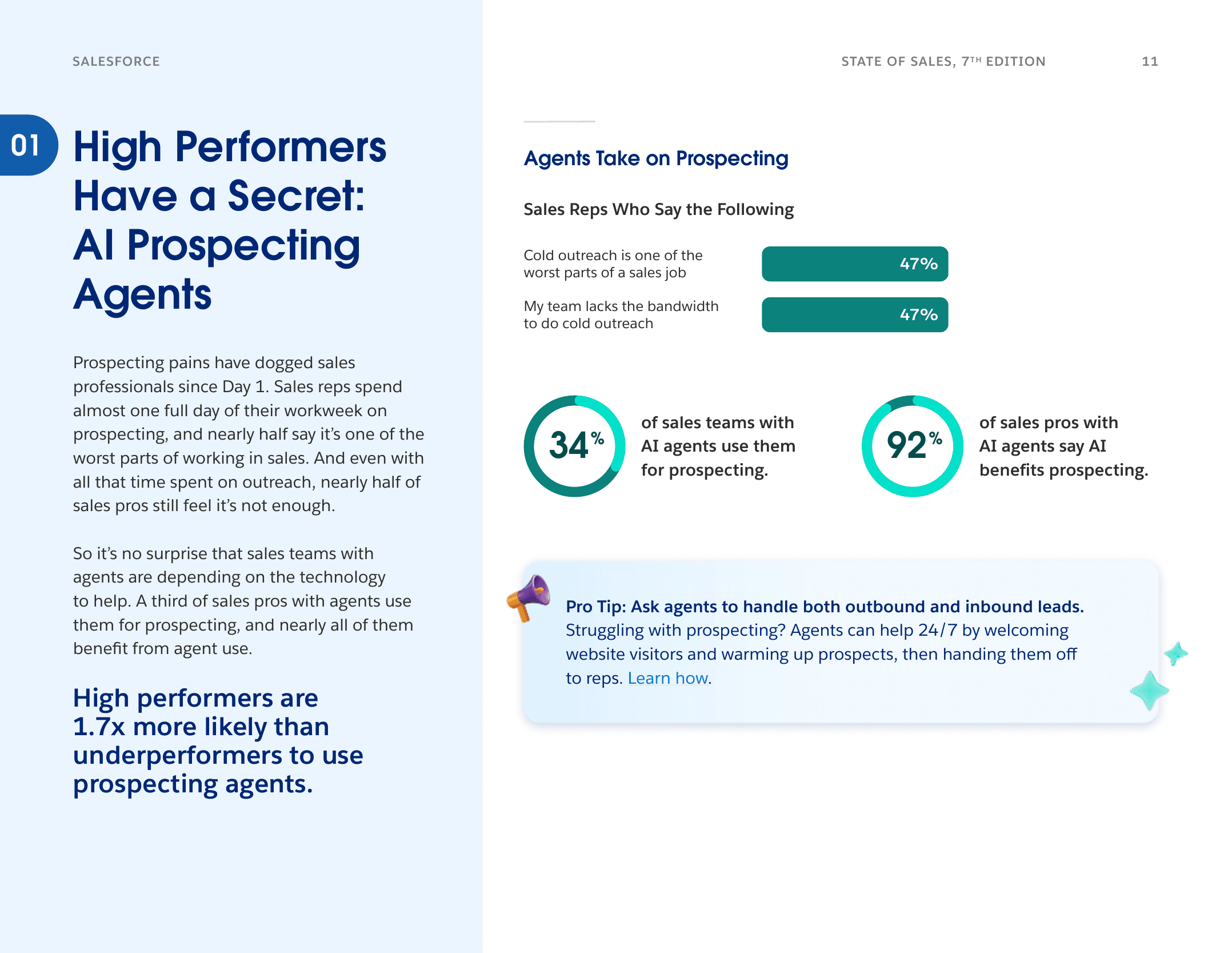
Source: Salesforce State of Sales, 7th Edition, 2026.
AI BDR vs AI SDR vs Human BDR
The most common question about AI BDRs is how they differ from AI SDRs. In practice, they do not. Some vendors use BDR (business development representative), others use SDR (sales development representative), and they describe the same thing: AI that automates outbound prospecting. The distinction between the two titles has always varied by company, and AI vendors use the terms interchangeably. For a deeper breakdown of the automation side, see AI Chatbot vs AI SDR.
What does differ is AI versus human, and the boundary between them:
| Dimension | AI BDR / AI SDR | Human BDR |
|---|---|---|
| Core job | Automate top-of-funnel outbound | Top-of-funnel outbound plus judgment work |
| Volume | Hundreds of touches per day | Dozens of thoughtful touches per day |
| Personalization | Data-driven, generated from firmographics | Researched, relationship-aware |
| Cost | Subscription or per-meeting | Salary, ramp time, and management |
| Works 24/7 | Yes | No |
| Strongest at | Reach and repetition | Nuance, objection handling, multi-threading |
| Weakest at | Handling the prospect who clicks and asks | Sustaining high volume across a large TAM |
Both the AI and the human share the same weak spot in one specific moment: the AI BDR fires off a cold email, the prospect clicks the link, and then they have a question. The sequence has nothing to say. That gap is the subject of the rest of this guide.
How an AI BDR Works
Under the hood, an AI BDR runs a loop that mirrors a human prospecting workflow:
You set the ICP - industry, company size, role, geography, trigger events. The AI pulls matching accounts and contacts from connected data sources.
For each contact, the agent gathers firmographic and technographic context and recent signals it can reference in outreach.
The AI drafts personalized first-touch messages for email and LinkedIn, then sends them across a managed cadence with deliverability controls.
It runs multi-touch follow-ups, handles simple replies, and books qualified meetings - handing anything nuanced to a human rep.
The whole loop is optimized for one metric: opens and replies that turn into booked meetings. Everything before the click is the AI BDR's territory. Everything after the click is not.
What an AI BDR Cannot Do
Here is the limitation that matters most, and the one the category rarely talks about. An AI BDR is a sender. It is built to push messages out. It is not built to be present when the prospect engages back.
Picture the moment a cold email actually works. The prospect reads the line, gets curious, and clicks the link to learn more. Now they have a question: Does this integrate with our CRM? What does pricing look like for a team of 40? How is this different from the tool we already use?
At that exact moment, the AI BDR has done its job and stepped away. The prospect lands on a static page, or worse, replies into a cadence that fires back another templated follow-up. The conversation the outreach created goes unanswered, and the buying signal in that question - the single most valuable thing the prospect just told you - is never captured.
This is not a flaw in any one product. It is structural. Outbound automation optimizes for reach. Answering the prospect who clicks is a different job on a different surface, with a different metric: depth, not volume. The same split shows up across the whole AI sales agent category, and it is why outbound and inbound agents are structurally different products.
The AI BDR opens the conversation. Who handles it?
Parsley is the presales agent that answers the prospect who clicks - and captures the buying signal in what they ask.
Get started freeWhere the Presales Agent Fits: After the BDR Opens the Door
Parsley is not an AI BDR. It does not build lists, write cold emails, or send a single outbound message. It is the complementary layer that handles the conversation the outbound starts.
Here is the division of labor. The AI BDR (or a human rep) opens the conversation by reaching out. Parsley handles and qualifies it from the moment the prospect clicks. You drop a Parsley link on your LinkedIn profile, then in cold emails, InMails, post-call recap emails, and email signatures - wherever your outbound lands. When the prospect clicks, an AI presales agent powered by Google Gemini answers their questions from your own sales docs, and passively captures first-party buyer intent from the conversation.
That intent is the part outbound automation throws away. When a prospect asks Parsley "how does this handle SOC 2?" or "can it sync to HubSpot for a 30-person team?", that question is a MEDDIC qualification signal - captured without a discovery call, scored, and synced to your CRM against a named contact. The rep who sent the link owns the signal and walks into the next call already knowing what the prospect cares about.
The reason this matters is that buyers now do most of their research before they ever talk to a rep. The conversation after the click is often the only window you get.
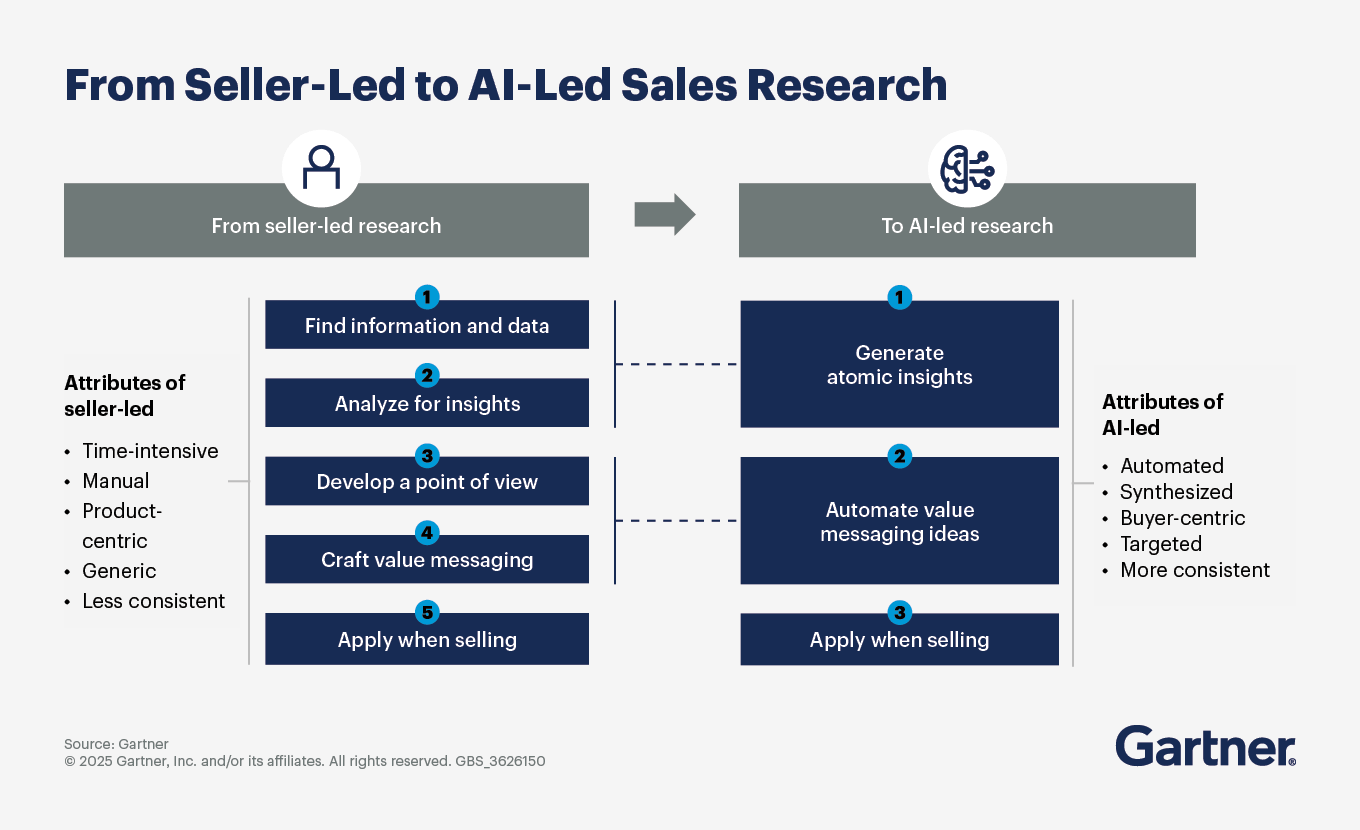
Source: Gartner, 2025.
The two layers stack cleanly. The AI BDR creates reach; the presales agent turns the clicks that reach generates into captured intent. SDRs and BDRs running outbound - human or AI - are exactly who this pairs with, which is why it is a natural fit for SDR-led teams. Both push their output into the same CRM record, so nothing about adding a presales layer disrupts the outbound motion already running.
Will AI BDRs Replace Human BDRs?
This is the question dominating the LinkedIn debate, and the honest answer is: not entirely, but the role is changing.
AI BDRs are absorbing the repetitive top-of-funnel work - list building, first-touch outreach, follow-up sequences. That genuinely reduces how many humans a team needs to push raw volume. But the judgment-heavy parts of the job - reading a hesitant reply, multi-threading across a buying committee, handling a real objection, deciding which accounts deserve a human touch - are not going anywhere. Those are getting more valuable as automation handles the rote work.
The teams winning with this are not choosing AI or humans. They are using AI for volume and humans for judgment, and adding a presales layer so the conversations all that volume creates actually get answered and qualified. Replacing the BDR is the wrong frame. Re-stacking the funnel around where AI is strong and where it is not is the right one. We have written more on that shift in agentic sales.
How to Evaluate an AI BDR
If you are assessing AI SDR tools, four questions cut through the marketing - and for a side-by-side of the leading options, see the best AI SDR tools for 2026:
- What does it actually replace? Some tools are a full outbound stack (data, sending, deliverability); others are a thin wrapper on top of tools you already pay for. Know which you are buying.
- How deliverable is the sending? High-volume AI outreach burns domains fast. Ask how the tool manages inboxes, warm-up, and deliverability before volume torches your sender reputation.
- How honest is the personalization? Generated-from-firmographics outreach is increasingly easy for prospects to spot. Test the actual message quality, not the demo.
- What happens after the click? This is the one most teams forget. An AI BDR books the meeting, but the prospect who clicks and asks a question is on their own unless you have a layer to answer them. That is the gap a presales agent fills.
Frequently Asked Questions
What is an AI SDR?
An AI SDR (AI sales development representative) is autonomous software that automates top-of-funnel outbound: building target lists, researching accounts, writing and sending cold outreach across email and LinkedIn, and booking qualified meetings. It does the prospecting work a human SDR would do, at higher volume and around the clock. Vendors use "AI SDR" and "AI BDR" to mean the same thing.
What is the difference between an AI BDR and an AI SDR?
In practice, nothing. Some vendors say BDR (business development representative) and others say SDR (sales development representative), but both describe AI that automates outbound prospecting - cold email, LinkedIn outreach, follow-up, and meeting booking. The SDR vs BDR distinction varies by company, and AI vendors use the terms interchangeably.
Will AI replace human BDRs?
Not entirely. AI BDRs take over the repetitive top-of-funnel work - list building, first-touch outreach, follow-up sequences - while human BDRs focus on judgment-heavy work like objection handling, multi-threading, and complex qualification. The role is shifting toward higher-leverage work with AI handling volume, not disappearing.
How much does an AI BDR cost?
Most AI BDR platforms are sold as a seat or a per-meeting subscription, typically several hundred to a few thousand dollars per month, positioned as cheaper than a human BDR. Pricing varies widely by volume and by how much of the outbound stack (data, sending, deliverability) the tool replaces.
Is Parsley an AI BDR?
No. Parsley does not send a single cold message. It is a presales agent that handles the conversation after an AI BDR or a human rep opens it: when a prospect clicks the link in an outbound message, Parsley answers their questions from your sales docs and captures first-party buyer intent. The BDR starts the conversation, the presales agent handles and qualifies it.
The Bottom Line
An AI BDR automates the start of the sales motion - finding prospects and reaching out at volume. It is real, it is adopted, and it is reshaping how top-of-funnel work gets done. But its job ends the moment a prospect clicks and asks a question, and that question is the most valuable signal in the whole sequence.
Parsley is the presales agent that handles that moment. Drop your link on your LinkedIn profile, in cold emails, InMails, and recap emails, and let the AI answer every prospect your outreach reaches - capturing what they want and syncing it to your CRM. The AI BDR starts the conversation. Parsley handles it.