Agentic Sales: What AI Means for Selling
84% of developers now use AI tools. Sales is next. Why agentic AI, AI SDRs, and autonomous sales agents will reshape how teams sell.
84% of software developers now use AI coding tools. 41% of all new code is AI-generated. Just three years ago, the industry consensus was that AI would never write production-quality software - and now the majority of developers use it daily. The shift was not gradual. It was a phase change.
Sales is about to go through the same thing.
Sales reps spend just 28-30% of their time actually selling. The rest goes to prospecting, data entry, CRM updates, research, and follow-ups - exactly the kind of repetitive, data-heavy work that AI handles well. The same forces that drove AI adoption in software development - pattern matching, data processing, and automating away the tedious parts of skilled work - are now arriving in sales. Agentic sales is not a buzzword. It is the same structural shift that already transformed how software gets built.
The Developer Precedent
The timeline in software development is instructive because it compressed years of expected change into months.
In 2023, most developers were sceptical. AI-generated code was a novelty - useful for boilerplate, unreliable for anything complex. By 2025, the Stack Overflow Developer Survey showed a completely different picture:
| Metric | Number |
|---|---|
| Developers using AI tools | 84% |
| Weekly usage | 65% |
| Daily usage | 51% |
| Code that is AI-generated | 41% |
| Using GPT-based models | 82% |
But here is the nuance that matters for sales: adoption outpaced trust. 46% of developers said they do not trust AI output. 75% manually review every line of AI-generated code. Developers adopted the tools because the productivity gains were too large to ignore - even while maintaining healthy scepticism about the output.
This is the pattern sales will follow. Teams will adopt AI sales agents and AI SDR tools not because they trust them completely, but because the alternative - spending 70% of your day on non-selling tasks while missing quota - is worse.
Why Sales Is Next
The structural parallels between software development and sales are hard to miss.
Developers spent enormous time on boilerplate, repetitive code, and debugging. AI tools automated those tasks and freed developers to focus on architecture, design, and complex problem-solving. Sales reps face the same dynamic: the time-consuming work (prospecting research, personalised outreach, data entry, note-taking, follow-ups) is exactly what AI handles well.
The numbers make the case:
- 70% of a sales rep's time goes to non-selling activities - research, admin, CRM updates, and internal coordination
- 78% of sellers missed quota in 2025, suggesting the current model is not working
- The AI SDR market reached $4.1 billion in 2025 and is projected to hit $15 billion by 2030, growing at 29.5% CAGR (Fortune Business Insights)
- $400 million+ in venture capital has flowed into AI SDR startups in the last two years
The parallel is direct:
| Developer task AI automated | Sales task AI is automating |
|---|---|
| Writing boilerplate code | Writing prospecting emails |
| Code review and bug detection | Lead scoring and qualification |
| Documentation generation | CRM data entry and updates |
| Test case creation | Prospect research and enrichment |
| Refactoring and optimisation | Sequence and cadence optimisation |
| Answering technical questions | Answering prospect questions (AI chatbots) |
The difference is timing. Developers are three years ahead on the adoption curve. Sales teams are at the point developers were in late 2023 - early adoption accelerating toward mainstream.
Anthropic's March 2026 research on labor market impacts of AI puts data behind this gap. Their radar chart maps theoretical AI capability against observed usage across occupations:
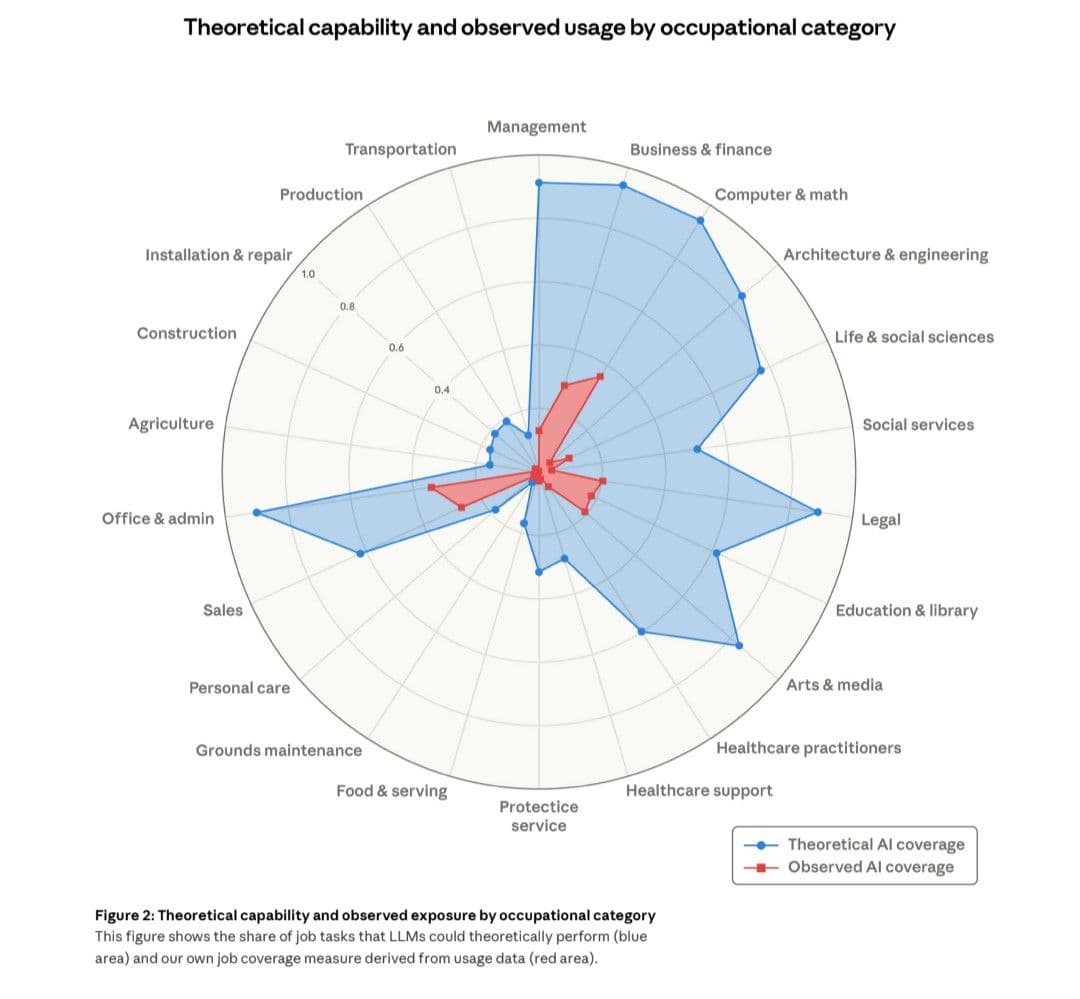
Source: Anthropic, "Labor Market Impacts of AI" (March 2026), Figure 2.
Computer & Math roles show ~95% theoretical coverage with ~33% observed usage - a gap that developers are actively closing (84% now use AI tools). Sales shows roughly 60% theoretical coverage but observed usage that barely registers. That 60% maps almost entirely to top-of-funnel work: prospecting, outreach, lead qualification, data entry - exactly the tasks that consume 70% of a rep's time. The relationship-driven half of selling (negotiation, complex deals, strategic accounts) stays human. The gap between what AI could automate in sales and what teams are actually using is the opportunity window - and it will not stay open as long as most sales leaders assume.
What "Agentic Sales" Actually Means
The term "agentic" gets thrown around loosely, so it is worth defining precisely. An agentic AI system acts autonomously - it does not just respond to prompts, it plans, decides, and executes multi-step tasks with minimal human oversight.
In sales, this plays out across three maturity levels:
AI assists the rep. It drafts emails, suggests talking points, summarises calls. The rep makes every decision. This is where most sales teams are today.
AI handles entire task categories. It runs prospecting sequences, qualifies inbound leads, books meetings, and updates the CRM - all without rep involvement for routine cases. Reps review and intervene on exceptions.
AI makes strategic decisions and executes end-to-end workflows. An autonomous sales agent identifies target accounts, researches decision-makers, crafts multi-channel outreach, qualifies responses, handles objections, and routes high-value opportunities to human reps. The AI is not following a script - it is adapting its strategy based on prospect behaviour.
The market is moving fast. Salesforce's Agentforce platform closed 18,500 deals and saw 330% year-over-year ARR growth, with an 84% self-resolution rate on customer interactions. Gartner predicts that 40% of enterprise applications will embed AI agents by 2026 - up from less than 5% in 2025. And 85% of enterprises are expected to implement AI agents by the end of 2026 (PwC).
The venture capital numbers confirm the trajectory. When $400 million flows into AI SDR startups in under two years, the market is making a clear bet on where sales is heading.
The AI SDR Wave
AI SDRs are the most visible form of agentic sales today because they tackle the most obvious bottleneck: the top of the funnel.
What AI SDRs handle now:
- Prospect research - identifying ideal customer profiles, enriching contact data, finding buying signals across public sources
- Personalised outreach - crafting emails and LinkedIn messages tailored to each prospect's role, company, and likely pain points
- Lead qualification - scoring inbound leads based on fit, intent signals, and engagement patterns
- Meeting booking - handling the back-and-forth of scheduling without rep involvement
- Follow-up sequences - maintaining cadence across channels with adaptive timing
The ROI data is compelling. Companies deploying AI sales agents report an average 171% ROI. McKinsey's State of AI report shows that marketing and sales is where organisations most commonly report revenue increases from AI - with 3-15% revenue gains and 10-20% improvements in sales ROI from AI-driven processes.
But here is the critical difference between AI in development and AI in sales: sales AI works with people, not just code. A developer's AI tool generates code that gets compiled and tested against objective criteria. A sales AI generates outreach that gets read by a human prospect who has preferences, emotions, and context that no model fully captures.
This is precisely why the shift is toward agentic rather than fully autonomous. The most effective model is not AI replacing reps - it is AI handling volume and velocity while humans handle nuance and relationships.
Start capturing buyer intent before the AI shift
Parsley's AI chatbot qualifies prospects through natural conversation - detecting MEDDIC signals and scoring leads automatically.
Get started freeWhat Does Not Change
The developer adoption story contains a warning that sales leaders should take seriously: 75% of developers manually review AI-generated code. Adoption did not mean blind trust. It meant using AI for speed and coverage while applying human judgment to quality and correctness.
Sales will follow the same pattern, and for good reason:
Trust still closes deals. Buyers making complex purchasing decisions want to talk to a person. They want someone who understands their specific situation, can negotiate terms, and will be accountable after the sale. An AI SDR can get the meeting - a human rep closes it.
Relationships compound over time. The best sales professionals build networks that generate referrals, expansions, and long-term revenue. AI cannot replicate the trust built through years of reliable partnership. What it can do is free reps from admin work so they have more time for relationship-building.
Context requires judgment. When a prospect's tone shifts, when a deal requires creative structuring, when a competitor makes an unexpected move - these situations require human judgment that AI handles poorly. The winning model is clear: AI handles research, outreach, and qualification at scale. Humans handle negotiation, relationships, and strategic decisions.
The developer parallel is exact. AI writes the boilerplate. Developers architect the system. AI qualifies the leads. Reps close the deals.
How to Prepare Your Sales Team
The developers who benefited most from AI tools were not the ones who resisted longest or adopted blindly. They were the ones who learned to work with AI effectively - reviewing output, providing good context, and focusing their own effort on the work AI could not do.
Sales teams should take the same approach:
-
Start capturing conversation signals now. The data that powers AI sales agents comes from real prospect interactions. Teams using AI chatbots on their profiles and websites are already building the dataset that makes future AI tools more effective. Passive buyer intent signals - captured from natural conversation rather than forms - are the highest-quality training data for agentic sales systems.
-
Build your knowledge base. Autonomous sales agents need comprehensive, accurate product and market information to work from. The teams investing in structured knowledge documents now will have a head start when agentic tools mature. This is the sales equivalent of well-documented codebases - AI works better when the source material is clear.
-
Adopt AI SDR tools for prospecting and qualification. You do not need to wait for fully agentic systems. Current AI SDR tools already handle prospect research, outreach personalisation, and lead scoring. Start with the tasks that consume the most rep time and deliver the least strategic value.
-
Keep humans in the loop for relationship-driven selling. The 75% manual review rate in development is not a bug - it is the correct operating model. AI handles volume. Humans handle judgment. Build workflows where AI does the first pass and reps focus their attention on the opportunities that matter.
-
Measure what matters. As AI takes over top-of-funnel activity, traditional metrics (emails sent, calls made, activities logged) become less meaningful. Focus on outcomes: time-to-first-response, signal quality, qualified pipeline generated, and conversion rates from AI-sourced leads versus traditional prospecting.
Frequently Asked Questions
What is agentic sales?
Agentic sales refers to AI systems that act autonomously in the sales process - not just assisting reps, but independently executing tasks like prospecting, outreach, qualification, and meeting booking. Unlike traditional sales automation that follows rigid rules, agentic AI adapts its approach based on prospect behaviour, makes strategic decisions about next steps, and handles multi-step workflows with minimal human oversight.
Will AI replace SDRs?
AI will replace specific SDR tasks - not the role entirely. Routine prospecting, initial outreach, lead qualification, and data entry are already being automated by AI SDR tools. But complex qualification, relationship building, and nuanced judgment remain human strengths. The more likely outcome mirrors what happened in development: SDRs who learn to work with AI tools become significantly more productive, handling larger territories and focusing on higher-value activities.
What is an AI SDR?
An AI SDR is software that automates the core functions of a sales development representative: identifying prospects, researching their companies and roles, crafting personalised outreach, qualifying responses, and booking meetings. Unlike traditional email automation that sends templated sequences, AI SDRs adapt their messaging based on prospect engagement, personalise at scale using real-time data, and make qualification decisions based on trained criteria.
How do AI sales agents work?
AI sales agents use large language models combined with structured data (CRM records, prospect information, product documentation) to autonomously execute sales tasks. They research prospects across public data sources, generate personalised communications, interpret responses, score leads based on engagement and intent signals, and route qualified opportunities to human reps. Advanced agents operate across multiple channels - email, LinkedIn, chat - and maintain context across interactions.
What is the difference between AI sales tools and agentic AI?
Traditional AI sales tools assist reps with specific tasks - a writing assistant helps draft emails, a call recorder summarises conversations, a scoring model ranks leads. These are copilot-level tools that require human initiation and oversight for every action. Agentic AI operates independently: it identifies what needs to be done, plans an approach, executes across multiple steps, and adapts based on results. The distinction is autonomy - agentic systems act, not just assist.
The Shift Is Already Underway
The question is not whether agentic sales will arrive - it is whether your team will be ready when it does. The developer community spent years debating whether AI would ever write real code. By the time sceptics came around, early adopters had already transformed their workflows and productivity.
Sales is following the same curve, roughly three years behind. The AI SDR market is growing at 29.5% annually. Enterprise AI agent adoption is projected to jump from 5% to 40% in a single year. The structural conditions - repetitive tasks consuming skilled workers' time, abundant data, and clear ROI - are identical to what drove the developer AI revolution.
The teams that start building their AI foundation now - capturing conversation signals, structuring their knowledge base, and integrating AI SDR tools into their workflow - will have compounding advantages as agentic systems mature.
Start building your AI-ready sales profile or see how Parsley works.
Related Articles: