Best Lead Scoring Software for B2B Sales Teams (2026)
We ranked 9 AI lead scoring tools for B2B sales teams - from HubSpot and Salesforce to PLG-focused platforms like MadKudu and first-party conversation scoring.
Why trust this list?
Peter Duffy has spent 20+ years in B2B sales and has used or evaluated most of the tools on this list first-hand. These recommendations are based on real experience - not sponsorships or affiliate deals.
Lead scoring software assigns numerical values to leads based on their likelihood to buy - combining demographic fit, firmographic data, and behavioral signals to help SaaS sales teams prioritize outreach. The concept isn't new, but the execution has changed dramatically. AI-powered models now replace static rule-based systems, and the best platforms in 2026 score leads dynamically as new signals arrive - critical in SaaS where trial signups, feature usage, and self-serve activity generate signals around the clock.
The problem is that most scoring models still depend on the same inputs: form fills, email opens, page visits, and CRM data. They measure engagement with your content - not buying intent. A lead who downloads three whitepapers might score higher than one who asked your chatbot detailed questions about API limits and SSO support. That's a gap worth closing.
This guide covers 9 lead scoring tools across four categories, compares their key features, and explains why conversation signals are the input most SaaS scoring models are missing.
Sources: Gartner, MarketingSherpa, 6sense Buyer Experience Report, InsideSales
Quick Navigation
- What Is Lead Scoring?
- The 9 Best Lead Scoring Tools
- Conversation-Signal Scoring
- Feature Comparison Table
- The Missing Input: Conversation Signals
- How to Choose
- FAQs
What Is Lead Scoring?
Lead scoring is the process of ranking leads by their sales-readiness using a combination of explicit data (who they are) and implicit data (what they do). For SaaS companies, this means combining firmographic fit - company size, industry, tech stack - with product signals like trial activity, feature adoption, and engagement patterns. Modern platforms go beyond simple point systems, using machine learning to identify the patterns that predict which trials convert and which accounts expand.
Core Capabilities
| Capability | What It Does |
|---|---|
| Rule-Based Scoring | Manual point assignment for demographics and actions |
| Predictive Scoring | ML models that learn from historical conversions |
| Behavioral Tracking | Monitors email opens, page visits, trial activity, and feature usage |
| Fit Scoring | Matches leads against your ideal customer profile (industry, ARR, tech stack) |
| Intent Scoring | Detects third-party research, G2 visits, and buying signals |
| Score Decay | Reduces scores over time when leads go inactive |
Why It Matters in 2026
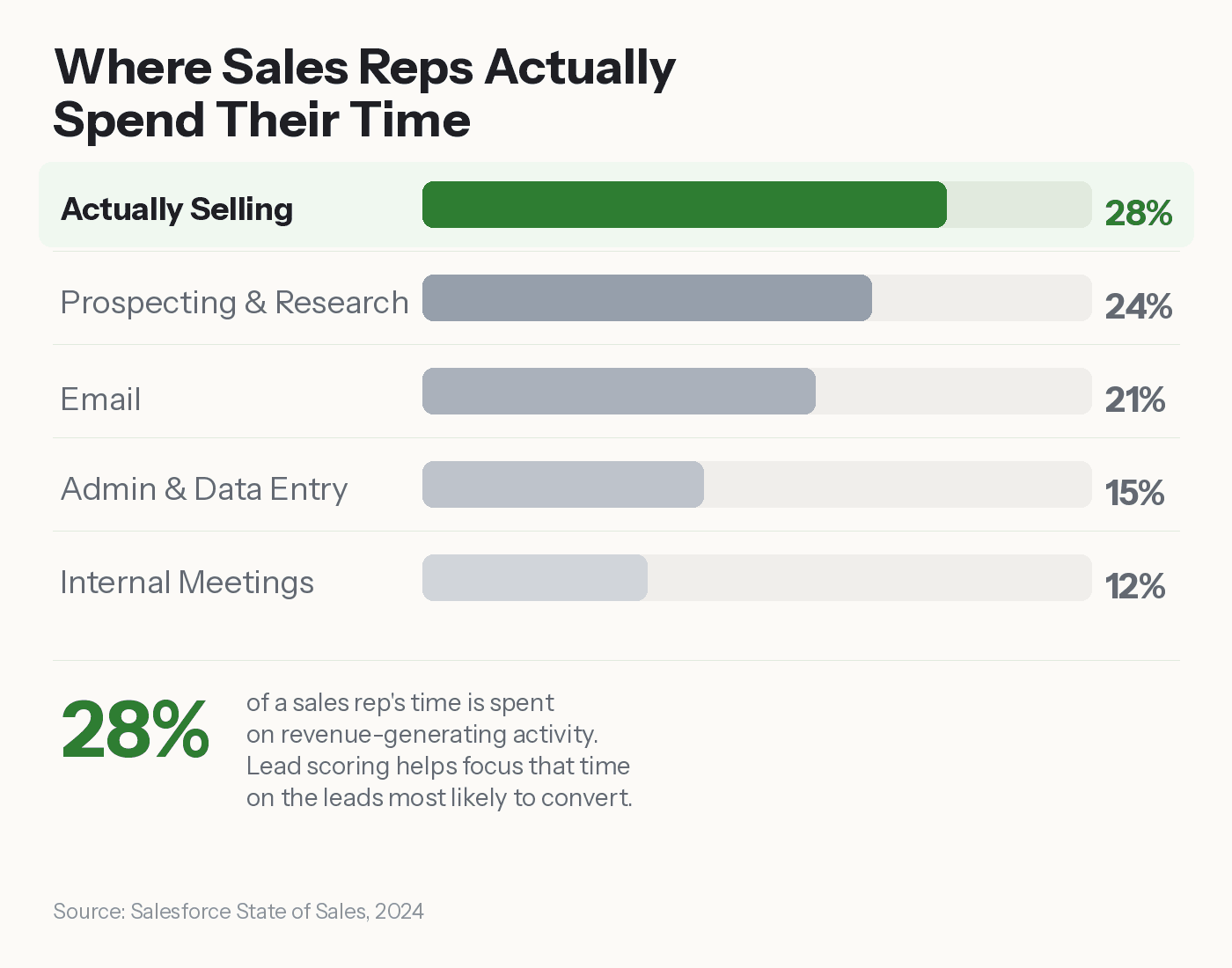
B2B SaaS buying committees have grown to an average of 6-10 decision makers, and 70% of the journey happens before a buyer ever talks to sales. When you're running a PLG motion or a high-velocity inside sales team, you can't follow up on every trial signup or demo request equally. Scoring solves the prioritization problem - but only if the inputs reflect actual buying intent, not just marketing engagement.
The shift from rule-based to predictive scoring was step one. The next shift is expanding what counts as a signal. Email opens and page visits tell you a lead is engaged. Trial signups, feature usage, and pricing page visits are better - but they still don't tell you a lead is ready to buy.
The 9 Best Lead Scoring Tools
We've organized these tools into four categories: enterprise CRM platforms with built-in scoring, AI-first scoring specialists, mid-market platforms that bundle scoring with broader sales and marketing automation, and conversation-signal tools that score leads on what prospects actually ask.
Enterprise CRM Platforms
These platforms embed lead scoring within a broader CRM and marketing automation ecosystem. If you already run one of these, their built-in scoring is the path of least resistance.
1. HubSpot - Best CRM-Native Scoring
Best for: SaaS teams already using HubSpot who want scoring without adding a vendor
HubSpot offers both manual and predictive lead scoring within its CRM. Manual scoring lets you assign points for any contact property or activity. Predictive scoring - available on Professional and Enterprise tiers - uses machine learning trained on your historical data to score leads automatically.
Key Strengths:
- Dual scoring models - Rule-based and predictive scoring in one platform
- Custom score properties - Create multiple scoring models for different segments
- Lifecycle stage automation - Trigger workflows when scores hit thresholds
- Unified data - Marketing and sales activity in one system
Limitations:
- Predictive scoring requires Professional or Enterprise tier ($800+/mo)
- Scoring inputs limited to HubSpot-tracked activities
- Less sophisticated than purpose-built scoring tools
Best For: SaaS teams already on HubSpot who want to activate scoring without adding another vendor to the stack. Popular with Series A-C companies running inbound + content-led motions.
2. Salesforce Einstein Lead Scoring - Best for Enterprise
Best for: Enterprise SaaS teams on Salesforce wanting AI-powered prioritization
Salesforce Einstein applies machine learning to your Salesforce data to score and prioritize leads. It analyzes your conversion history, identifies the patterns that predict success, and scores new leads accordingly - all within the Salesforce UI.
Key Strengths:
- Auto-learning models - Continuously retrained on your conversion data
- Transparent scoring - Shows which factors drive each lead's score
- Native integration - Lives inside Salesforce, no data syncing required
- Scale - Handles massive lead volumes without performance issues
Limitations:
- Requires Salesforce Enterprise Edition or higher
- Model quality depends on your historical data volume and cleanliness
- Setup and tuning need a skilled Salesforce admin
Best For: Enterprise SaaS teams with a mature Salesforce instance and enough historical conversion data to train predictive models. Common in late-stage companies with 50+ reps.
3. Marketo Engage - Best for Marketing-Led Scoring
Best for: Marketing teams running complex multi-touch nurture programs
Marketo Engage (Adobe) offers deeply configurable lead scoring tied to its marketing automation engine. You can build scoring models that account for demographic fit, behavioral engagement, and campaign interactions across channels.
Key Strengths:
- Granular scoring rules - Score on virtually any attribute or behavior
- Multi-touch attribution - Understand which touches drive conversions
- Account scoring - Roll up individual lead scores to the account level
- Program-based scoring - Tie scores to specific campaigns and content
Limitations:
- Steep learning curve - requires dedicated Marketo expertise
- Expensive - enterprise pricing with long contracts
- Rule-based by default - predictive scoring requires add-ons
Best For: Marketing operations teams with complex nurture programs who need granular control over scoring logic.
AI Scoring Specialists
These platforms focus specifically on predictive lead scoring and qualification - using machine learning and intent data that go beyond what CRM-native scoring offers.
4. MadKudu - Best for Product-Led Growth
Best for: PLG SaaS companies needing to identify sales-ready users from free tiers
MadKudu specializes in predictive scoring for product-led SaaS companies. It combines product usage data, firmographic enrichment, and behavioral signals to identify which free-tier users are most likely to convert to paid plans - or which self-serve customers are ready for an enterprise conversation. If you're running a freemium or free-trial motion, this is the tool built for your GTM.
Key Strengths:
- Product usage scoring - Scores based on actual in-app behavior
- Real-time qualification - Identifies PQLs as they emerge
- Custom models - Trained on your specific conversion patterns
- CRM and Slack alerts - Notifies reps when high-score users appear
Limitations:
- Most valuable for product-led motions - less relevant for traditional outbound
- Requires product event data integration (Segment, Amplitude, etc.)
- Pricing starts higher than CRM-native alternatives
Best For: PLG SaaS companies that need to route high-potential free users to sales without disrupting the self-serve experience. Used by companies like Figma, Notion, and Loom.
5. 6sense - Best for Intent-Based Scoring
Best for: Enterprise SaaS ABM teams wanting to score accounts by buying stage
6sense goes beyond individual lead scoring to score entire accounts by their position in the buying journey. It combines anonymous intent data, firmographic fit, and engagement history to predict which accounts are actively in-market - often before they've filled out a form or started a trial.
Key Strengths:
- Account-level scoring - Scores buying committees, not just individuals
- Anonymous intent - Detects research activity before leads self-identify
- Buying stage prediction - Maps accounts to awareness, consideration, or decision
- Orchestration - Triggers multi-channel plays based on score changes
Limitations:
- Enterprise pricing - not accessible to SMBs
- Requires alignment between marketing and sales to act on scores
- Account-level scoring may miss individual champion signals
Best For: Enterprise SaaS ABM teams with large total addressable markets who need to identify in-market accounts before competitors do. Strong fit for companies selling to mid-market and enterprise buyers with long sales cycles.
Your scoring model is missing an input
Parsley captures the questions SaaS prospects ask before they ever talk to sales - about integrations, pricing tiers, and implementation timelines - and syncs intent signals to your CRM within 24 hours.
Get started freeMid-Market All-in-One
These platforms bundle lead scoring with broader sales and marketing automation - giving mid-market teams scoring capabilities without enterprise pricing.
6. ActiveCampaign - Best for Small Teams
Best for: Early-stage SaaS teams wanting scoring bundled with email automation
ActiveCampaign combines email marketing, marketing automation, CRM, and lead scoring in a single platform. Its scoring system tracks both contact-level engagement and deal probability, making it accessible for lean SaaS teams without dedicated RevOps.
Key Strengths:
- Simple setup - Point-and-click scoring rules, no coding required
- Automation integration - Trigger workflows when scores change
- Deal scoring - Separate scores for contact engagement and deal likelihood
- Affordable - Lead scoring available from the Plus plan ($49/mo)
Limitations:
- Rule-based only - no predictive or AI scoring
- Less granular than enterprise platforms
- Scoring inputs limited to ActiveCampaign-tracked activities
Best For: Early-stage SaaS teams who want lead scoring as part of an affordable marketing automation platform - before investing in HubSpot or Salesforce.
7. Freshsales - Best Budget Option
Best for: Budget-conscious teams wanting AI scoring at startup pricing
Freshsales (Freshworks) includes Freddy AI - a machine learning scoring engine that ranks leads based on engagement, fit, and intent signals. It's one of the most affordable platforms to offer AI-powered scoring.
Key Strengths:
- Freddy AI scoring - Predictive scoring included at mid-tier pricing
- Contact lifecycle tracking - Automatic stage progression
- Built-in phone and email - Engagement data flows into scoring automatically
- Free tier - Basic CRM with up to 3 users at no cost
Limitations:
- AI scoring accuracy improves with data volume - lean datasets limit results
- Smaller ecosystem of integrations than HubSpot or Salesforce
- Less mature than established enterprise alternatives
Best For: SaaS startups and small teams who want predictive scoring without enterprise pricing. A solid choice pre-Series A when every dollar counts.
8. Zoho CRM - Best for Value
Best for: Cost-conscious teams wanting configurable scoring in a full CRM
Zoho CRM offers rule-based lead scoring with its Zia AI assistant providing predictive capabilities on higher tiers. Scoring rules can account for demographic data, email engagement, social interactions, and website visits.
Key Strengths:
- Configurable rules - Score on any CRM field or tracked behavior
- Zia AI predictions - Predictive scoring on Enterprise tier
- Multi-channel tracking - Scores from email, social, phone, and web
- Competitive pricing - Full CRM with scoring from $14/user/mo
Limitations:
- Zia AI predictions require Enterprise tier ($40/user/mo)
- UI can feel cluttered compared to modern alternatives
- Predictive accuracy depends on data volume and quality
Best For: Cost-conscious teams who want deep CRM functionality and scoring at a price point well below HubSpot or Salesforce.
Conversation-Signal Scoring
Every tool above scores leads on what prospects do - pages visited, emails opened, features activated. This last category scores them on what they say.
9. Parsley - Best for First-Party Conversation Signals
Best for: Outbound sales teams that want scoring driven by prospects' own questions, not inferred behavior
Parsley is the AI presales agent for LinkedIn and email, powered by Google Gemini. Reps drop a Parsley link on their LinkedIn profile and in outbound emails; the agent answers prospects' questions from the team's own sales docs and scores each conversation as it happens. Buyer intent lands as a Hot, Warm, or Cold temperature, with a separate MEDDIC qualification read, and both sync to the CRM.
Key Strengths:
- First-party signal - Scores from what prospects ask, not third-party intent models or cookie tracking
- Passive MEDDIC detection - Qualification inferred from natural conversation, never an interrogating questionnaire
- Two independent reads - Buyer intent temperature and a "N of 6" MEDDIC scorecard, kept separate so a chatty lead isn't mistaken for a qualified one
- Works pre-website - Captures intent on outbound surfaces, before a prospect ever reaches your site
- Usage-based pricing - 25 cents per conversation with no subscription and unlimited team seats
Limitations:
- Scores conversations, so it needs prospects to engage with the link before it produces a signal
- Not a standalone CRM - it feeds scores into HubSpot, Attio, Salesforce, Salesflare, Folk, Twenty, Copper, or Capsule
- No anonymous website visitor resolution (a different data model from 6sense or RB2B)
Best For: SDR and AE teams running LinkedIn and email outbound who want to know what each prospect actually wants before the first call. Strongest as a complement to a CRM-native or predictive scorer rather than a replacement for one.
Feature Comparison Table
| Tool | Scoring Type | AI/Predictive | Intent Data | CRM Built-In | Starting Price |
|---|---|---|---|---|---|
| HubSpot | Rule + Predictive | Yes (Pro+) | Website visits | Yes | $800/mo (Pro) |
| Salesforce Einstein | Predictive | Yes | Add-on | Yes | Enterprise tier |
| Marketo | Rule-based | Add-on | Add-on | No (needs CRM) | Custom pricing |
| MadKudu | Predictive | Yes | Product usage | No | Custom pricing |
| 6sense | Account-level | Yes | 3rd-party intent | No | Enterprise tier |
| ActiveCampaign | Rule-based | No | Email/web only | Yes | $49/mo (Plus) |
| Freshsales | AI (Freddy) | Yes | Email/web | Yes | Free - $39/mo |
| Zoho CRM | Rule + Zia AI | Yes (Ent) | Email/web/social | Yes | $14/user/mo |
| Parsley | Conversation | Yes | 1st-party intent | No (syncs) | 10c/conversation |
The Missing Input: Conversation Signals
Lead scoring models have gotten smarter - predictive algorithms, intent data, and product usage signals have all improved accuracy. But there's a category of signal that almost no scoring model captures: what prospects actually ask when they're evaluating your SaaS product.
Consider the typical inputs to a SaaS lead scoring model:
| Signal Type | Example | What It Tells You |
|---|---|---|
| Demographic | VP of Sales at a 200-person SaaS company | Good fit |
| Product | Activated 3 features during trial, invited 2 teammates | High-intent trial |
| Behavioral | Visited pricing page 3 times, compared plans | Evaluating |
| Intent | Researching "sales intelligence tools" on G2 | In-market |
| Conversation | Asked about SSO, API limits, and annual pricing | Ready to buy |
The first four are standard. The last one - conversation signals - is where the gap exists. A prospect who asks your AI chatbot "Do you support SAML SSO?" and "What's the pricing for a 50-seat team on an annual plan?" is demonstrating stronger buying intent than someone who downloaded a whitepaper. But most scoring models can't see those questions.
Why Conversation Signals Matter
Buyer intent captured from conversation is fundamentally different from behavioral tracking. Page visits tell you a lead is browsing. Content downloads tell you a topic is relevant. But direct questions reveal:
- Technical requirements - "Do you support SAML SSO?" or "Is there a Salesforce integration?" tells you exactly what their stack needs
- Budget and packaging - "What's included in the Business tier?" signals they're past research and into evaluation
- Competitive evaluation - "How does this compare to Gong?" means they're actively shortlisting
- Timeline urgency - "Can we implement before Q3?" or "Do you offer a pilot program?" tells you when they want to move
These signals map directly to qualification frameworks like MEDDIC - and they're generated passively, without a rep ever asking a qualifying question. See how buyer intent software feeds conversation signals into your scoring model.
Scoring and qualification are related but distinct jobs: scoring ranks leads against each other, while qualification decides whether a lead should advance at all. If your problem is the latter, see our roundup of the best lead qualification software.
Adding Conversation Data to Your Scoring Model
Parsley captures these conversation signals through a presales agent that runs on your LinkedIn profile and in your outbound email. When SaaS prospects ask questions - about API access, pricing tiers, integrations, or how you compare to competitors - those questions are classified by topic and mapped to MEDDIC signals, then synced to your CRM.
The result: your lead scoring model gains an input it never had before. A trial user who asks three integration questions and a competitor comparison scores higher than one who just activated a feature. And your AEs walk into demos knowing exactly what the prospect cares about - before they say a word.
See how it works or explore the sales intelligence tools that complement conversation-based scoring.
How to Choose the Right Tool
By Scoring Maturity
| Stage | Best Fit | Why |
|---|---|---|
| No scoring yet | HubSpot, ActiveCampaign | Simple rule-based setup, fast time-to-value |
| Basic rules in place | Salesforce Einstein, Freshsales | Add AI predictions to improve accuracy |
| Advanced scoring | 6sense, MadKudu | Specialized models for intent and PLG |
| Optimizing existing models | Parsley + any tool | Add conversation signals as a new input |
By Team and Motion
| SaaS Sales Motion | Best Fit | Why |
|---|---|---|
| Inbound / content-led | HubSpot, Marketo | Score leads as they engage with content |
| Outbound / ABM | Salesforce Einstein, 6sense | Prioritize target accounts by fit + intent |
| Product-led growth | MadKudu, Freshsales | Score based on trial and product usage |
| Hybrid PLG + sales | MadKudu + HubSpot, 6sense | Combine product signals with sales data |
| Early-stage / lean | ActiveCampaign, Zoho CRM | Affordable scoring before scaling RevOps |
By Budget
| Budget | Recommendation |
|---|---|
| $0/mo | Freshsales free tier or Zoho CRM free edition |
| $15-50/mo | Zoho CRM Standard or ActiveCampaign Plus |
| $50-500/mo | HubSpot Starter or Freshsales Pro with Freddy AI |
| $500-2,000/mo | HubSpot Professional or Salesforce with Einstein |
| $2,000+/mo | 6sense, MadKudu, or Marketo for specialized needs |
Frequently Asked Questions
What is lead scoring software?
Lead scoring software automatically ranks your leads by sales-readiness using a combination of fit data (who they are) and behavioral data (what they do). The output is a numerical score that helps sales teams prioritize follow-up - spending time on the leads most likely to convert rather than working through a list sequentially.
What's the difference between rule-based and predictive lead scoring?
Rule-based scoring uses manually configured points - for example, +10 for visiting the pricing page, +5 for opening an email, -10 for having a free email domain. You define the rules. Predictive scoring uses machine learning to analyze your historical conversion data and automatically identify which attributes and behaviors predict a sale. Predictive models adapt as your data changes - rule-based models need manual updates.
How much data do I need for predictive lead scoring to work?
Most predictive scoring platforms need at least 100-500 historical conversions to train an accurate model. The more data points per lead (demographics, behavior, engagement history), the better the model performs. If you have fewer than 100 conversions, start with rule-based scoring and switch to predictive once you've built enough history.
Can lead scoring work for early-stage SaaS teams?
Yes. Platforms like ActiveCampaign, Freshsales, and Zoho CRM offer lead scoring at price points accessible to pre-Series A teams. You don't need enterprise budgets or dedicated RevOps to get started. Even a simple rule-based model - scoring for job title, company size, trial activity, and pricing page visits - can improve how your team prioritizes leads and focus limited AE time on the highest-potential accounts.
How do conversation signals improve lead scoring?
Most SaaS scoring models rely on indirect signals - page visits, email opens, trial signups, feature adoption. Conversation signals capture direct buying intent: the specific questions prospects ask about pricing tiers, integrations, security compliance, and competitors. A lead who asks "What's the pricing for a 50-seat annual plan?" demonstrates stronger intent than one who visited the pricing page. Tools like Parsley capture these signals through AI chatbots and sync them to your CRM, giving your scoring model an input it otherwise wouldn't have.
Should I use my CRM's built-in scoring or a standalone tool?
Start with your CRM's built-in scoring if it offers one. HubSpot, Salesforce, Freshsales, and Zoho all include scoring capabilities. Switch to a standalone tool when you need capabilities your CRM doesn't offer - like account-level scoring (6sense), product usage scoring (MadKudu), or conversation-based intent signals (Parsley). Adding a specialized tool makes sense once you've outgrown what your CRM provides natively.
The Bottom Line
Lead scoring software has evolved from static point systems to AI-powered platforms that learn from your data. The 9 tools in this guide span the full range - from budget-friendly CRMs with basic scoring to enterprise platforms with predictive models, plus first-party conversation signals.
Quick decision guide:
| If you need... | Choose |
|---|---|
| CRM-native scoring (HubSpot) | HubSpot Lead Scoring |
| Enterprise predictive scoring | Salesforce Einstein |
| Marketing-led scoring | Marketo Engage |
| PLG user qualification | MadKudu |
| Account-level intent scoring | 6sense |
| Affordable automation + scoring | ActiveCampaign |
| AI scoring at startup pricing | Freshsales |
| Value CRM with scoring | Zoho CRM |
| Conversation-based intent signals | Add Parsley to any tool |
But the bigger opportunity isn't choosing the right tool - it's expanding the signals your scoring model sees. Most SaaS scoring models measure what leads do on your website, in your product, and in your emails. They miss what leads ask when they're evaluating independently - questions about integrations, pricing tiers, security, and how you compare. These conversation signals are the highest-intent data points available, and almost no scoring model captures them today.
Parsley adds that missing input. Your lead scoring tool tells you who to prioritize. Parsley tells your AEs what the prospect actually wants to talk about - before the first call.
Related Articles: